


Funke Stickerei
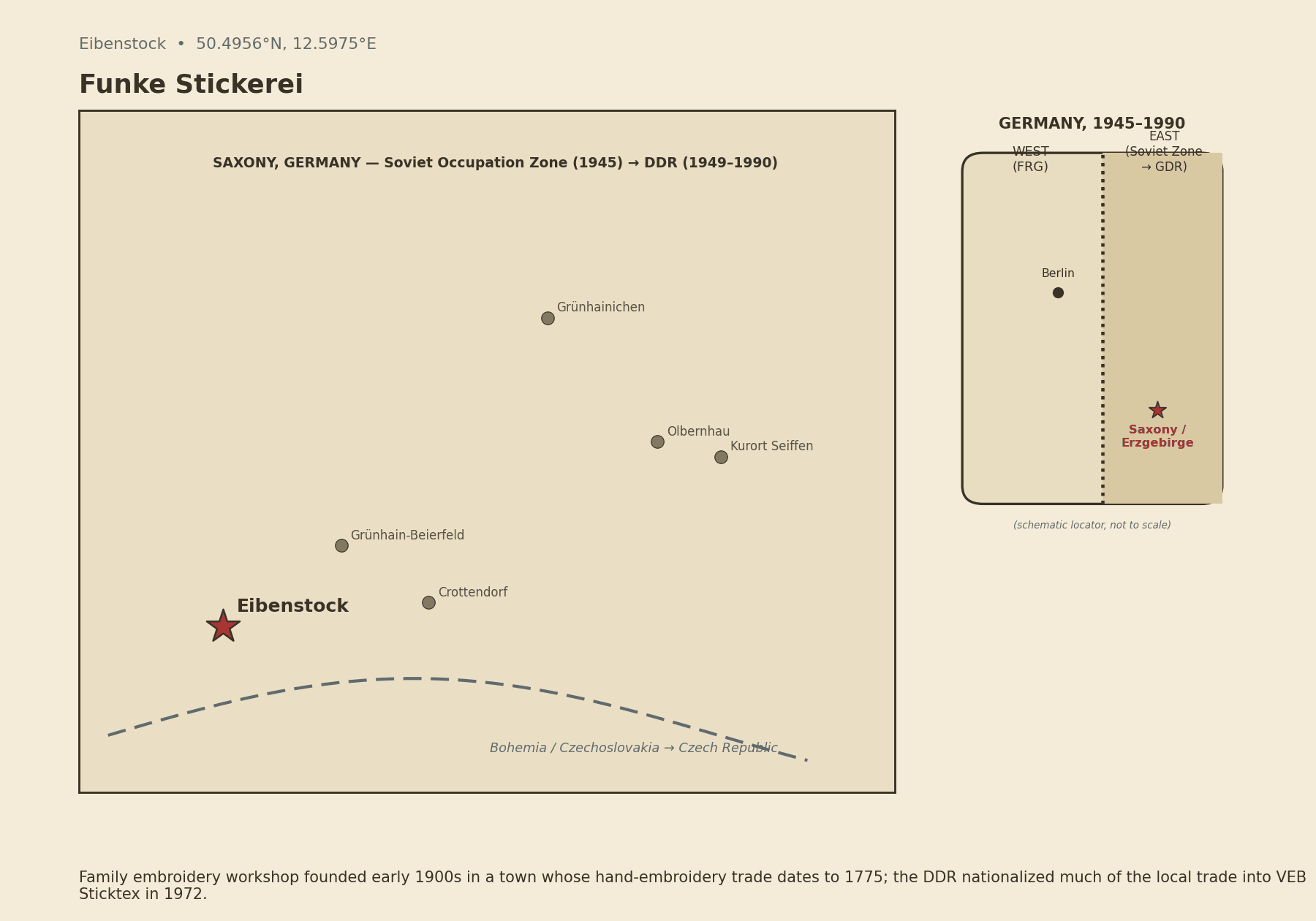
Funke Stickerei works in a different Erzgebirge tradition than most names on this list — embroidery, not wood. The company is based in Eibenstock, a town whose hand-embroidery trade dates all the way back to 1775, and where the United States once kept a consulate open for eight years, from 1891 to 1908, for no reason other than to manage the local embroidery trade with America.
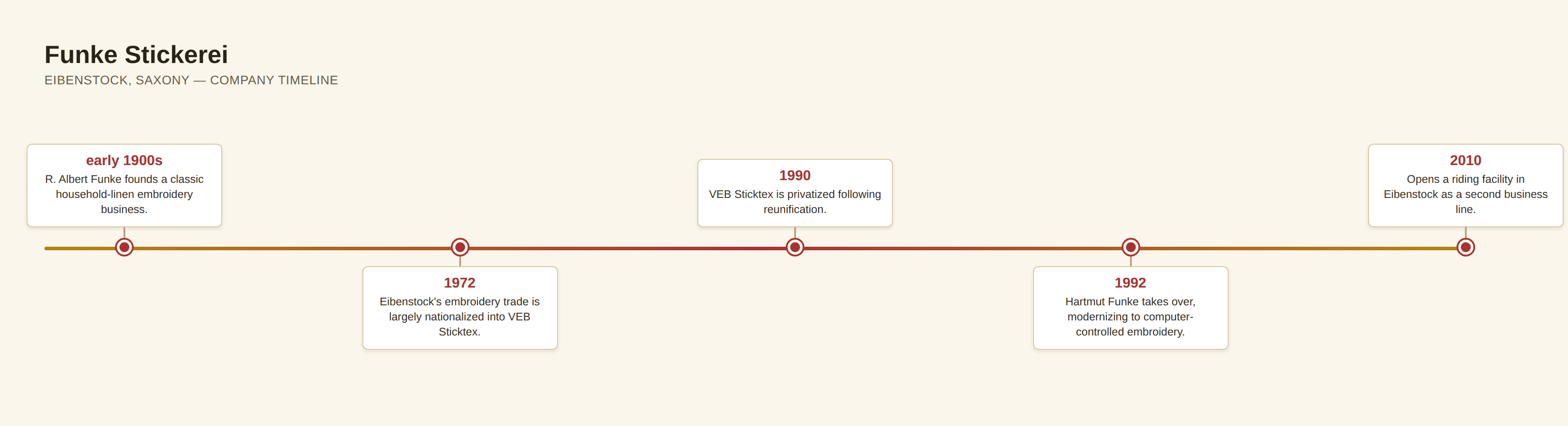
Founded in the early 1900s by R. Albert Funke as a household-linen embroidery business, the company is now run by his grandson Hartmut Funke, who took over in 1992 and replaced machinery dating to 1910 with computer-controlled multi-head embroidery equipment. Funke holds a patent on a stain-resistant embroidery process for tablecloths, and by the company's own account is now Germany's largest supplier of embroidered table linens.
The full story: a Polish-born teacher, an American consulate, and a Cold War state takeover
Eibenstock's embroidery tradition doesn't start with the Funke family — it starts in 1775 with Clara Angermann, a woman born in Białystok in 1754 who trained in tambour and chain-stitch embroidery at a convent near Toruń before settling in Eibenstock with her uncle. Over five years she taught local women the technique, reviving a town whose mining economy had been declining. The trade grew fast: six embroidery firms by 1850, fifty-seven by 1914, and enough transatlantic business that the United States maintained a consulate in Eibenstock from 1891 to 1908 purely to manage embroidery exports — an almost unbelievable detail for a small Saxon mountain town, but a well-documented one.
R. Albert Funke founded his own embroidery business in the early 20th century, riding the tail end of that boom before the First World War collapsed international demand and the industry never fully recovered its prewar scale. What happened next in Eibenstock, town-wide, is well documented even where Funke's own firm-specific history is thinner: the DDR consolidated much of the local embroidery trade into a cooperative in 1959, then converted it into VEB Sticktex Eibenstock in 1972, absorbing a number of formerly private local firms. We could not independently confirm whether the Funke family's own business was one of the firms folded into that state enterprise, or whether it continued operating privately alongside it — the surviving sources describe the town-level nationalization clearly but don't name every firm involved.
What's certain is what happened after: VEB Sticktex was itself privatized in 1990 following reunification, and in 1992 Hartmut Funke took the family business forward, tearing out equipment that in some cases dated to 1910 and replacing it with modern computerized embroidery machines. He expanded into promotional and advertising textiles through the 1990s and developed the company's patented stain-resistant tablecloth line. In 2010, in an unexpected diversification, the company opened a riding facility in Eibenstock as a second business line alongside the embroidery trade — proof that a 100-plus-year-old craft business can still take a genuine swing at something new.
Historical details above reflect publicly available sources as of 2026 and are presented in good faith; company-specific dates for small family workshops are sometimes thinly documented, and we've noted where regional context (rather than firm-specific record) is being described.