


KWO Kunstgewerbe-Werkstätten Olbernhau
KWO — short for Kunstgewerbe-Werkstätten Olbernhau — has been turning Erzgebirge incense smokers and nutcrackers since 1949, the same year East Germany came into existence as a separate state. The company's specialty is the Kantenhocker, an "edge-sitter" smoker figure designed to perch on a shelf lip rather than stand flat, alongside the more familiar lineup of pyramids, Schwibbögen, and hand-painted angels.
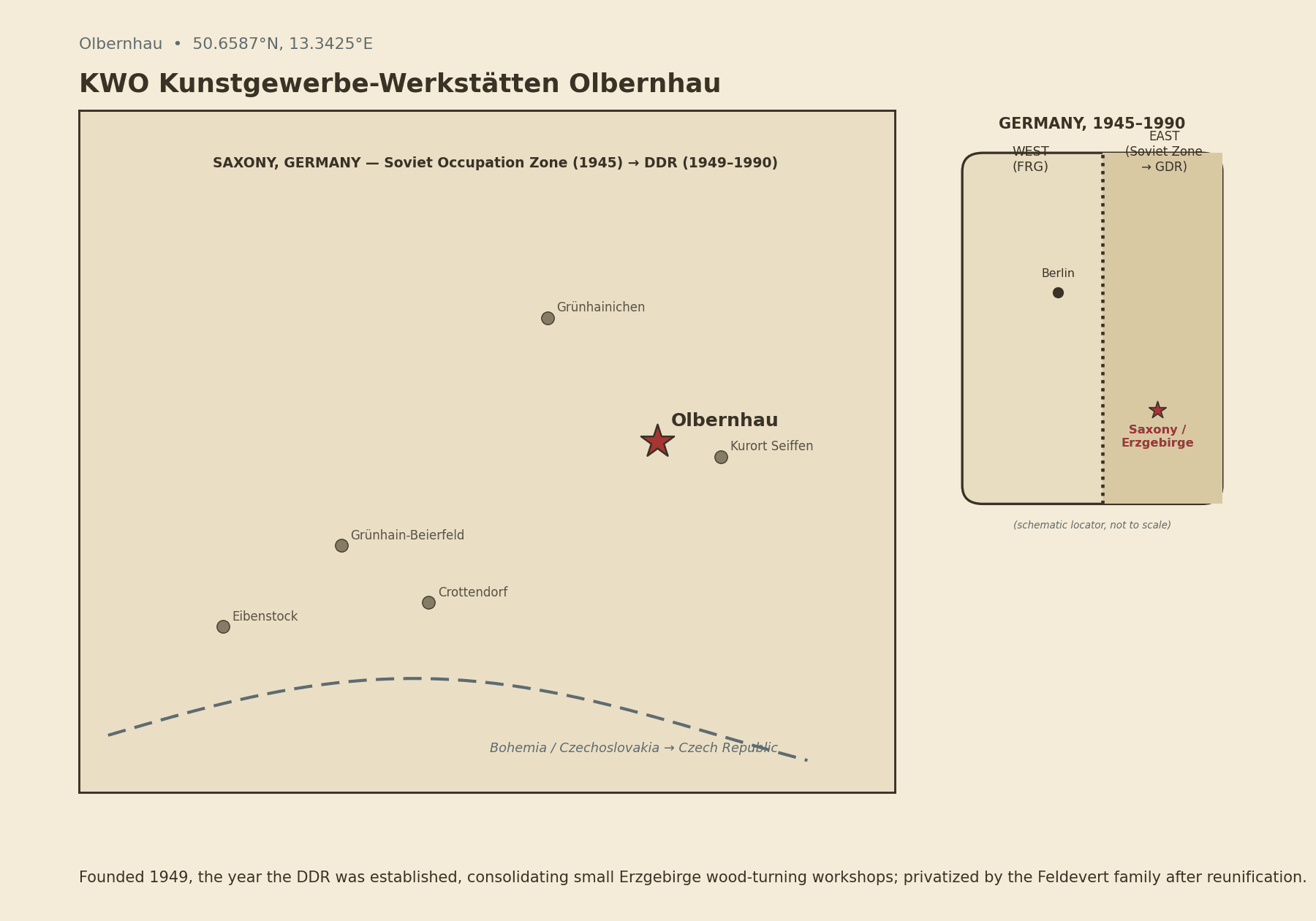
The workshop sits in Olbernhau, a town a few miles from Seiffen that became a genuine industrial center under East German rule, home to combines that made everything from rolled steel to wooden toys at scale. KWO itself has been privately run since German reunification, now under a third generation of the Feldevert family, and its work has picked up recognition including the German Toy Design Prize and the Saxon State Design Prize along the way.
The full story: Olbernhau's industrial DDR backdrop
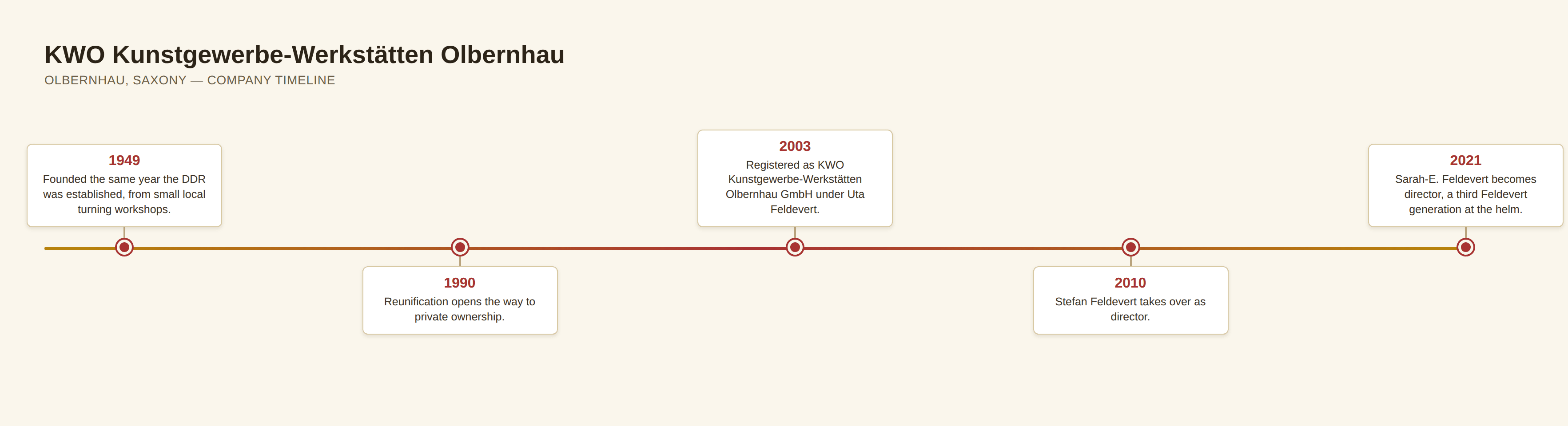
KWO traces its roots to 1949 — the year the Soviet occupation zone formally became the German Democratic Republic — when a workshop making turned wooden components for other Erzgebirge toy makers began operating in Olbernhau. Some local sources describe this founding as a consolidation of several smaller family businesses into a single state-recognized workshop, in keeping with the East German pattern of merging small craft producers, though the surviving documentation for KWO's own early corporate structure is thinner than for some of its neighbors.
What is well documented is the scale of DDR-era industry in Olbernhau itself. The town became home to VEB Blechwalzwerk, a state rolling mill employing over 600 workers, and sat near VEB Kombinat Holzspielwaren VERO, the DDR's largest wooden-toy and model-railway producer — an enterprise built by forcibly consolidating roughly 99 private workshops between 1966 and the early 1980s into a combine of some 27,000 employees region-wide. KWO was a distinct, smaller operation, but it grew up in that same industrial environment, one shaped almost entirely by state planning rather than private ownership.
Reunification changed that. The Feldevert family took over KWO after 1990, and leadership has passed down within the family since: Uta Feldevert registered the modern GmbH in 2003, her son Stefan Feldevert took over as director in 2010, and Sarah-E. Feldevert has led the company since 2021 — a third generation now running a business whose first generation was shaped entirely by state policy rather than family succession.
Visit KWO Kunstgewerbe-Werkstätten Olbernhau’s official site →
Historical details above reflect publicly available sources as of 2026 and are presented in good faith; company-specific dates for small family workshops are sometimes thinly documented, and we've noted where regional context (rather than firm-specific record) is being described.