
Seiffener Volkskunst eG
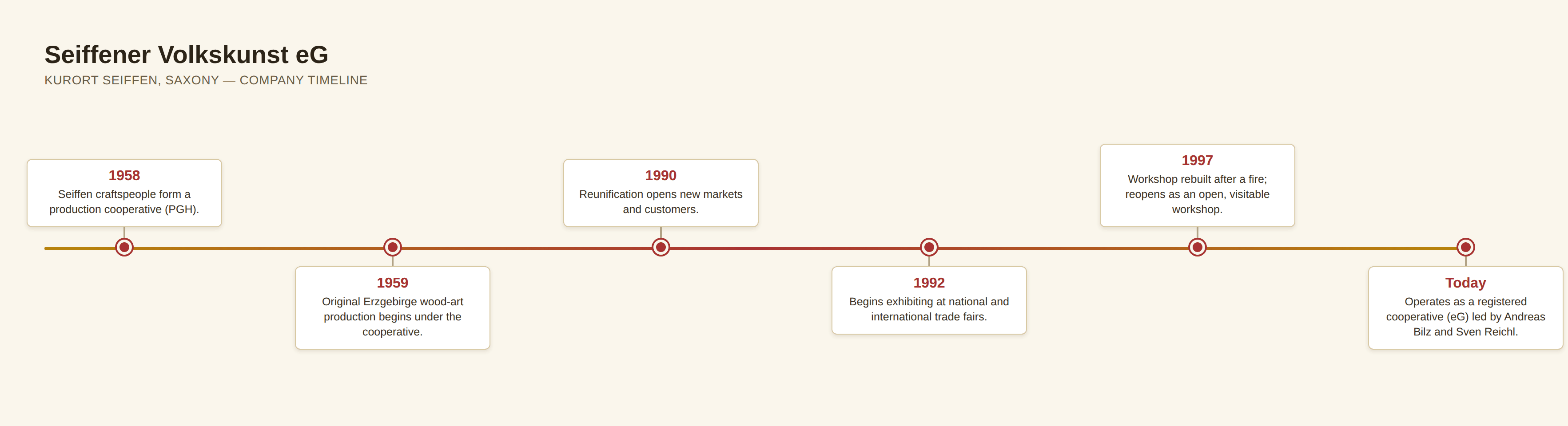
Seiffener Volkskunst eG is a cooperative, not a single family's workshop — which is exactly why it's worth knowing the difference. It was formed in 1958 in Seiffen, the Saxon village that's been synonymous with German wood-turned Christmas figures since the 1700s, when a group of local craftspeople pooled their workshops together rather than compete against each other piece by piece.
That cooperative structure survives today as an "eG," a registered cooperative under German law, and it's still headquartered a short walk from where it started. The lineup covers the full range of Seiffen tradition: Räuchermänner (incense smokers), pyramids, Schwibbögen candle arches, and the carved miner and angel figures that have marked German Christmas markets for generations. A 1997 fire took out the original workshop building, and the cooperative rebuilt it as an open workshop where visitors now watch the carving and painting happen in real time.
The full story: a cooperative born out of the Cold War's craft economy
Seiffen's woodworking tradition runs deep — residents were exporting turned toys to Nuremberg as early as 1699, and by 1868 nearly two-thirds of the village's population worked in wood or toy production. That density of small, independent workshops became a policy problem for the East German state after 1949. Rather than nationalize every workshop outright, the DDR encouraged small craftspeople into producer cooperatives known as PGH (Produktionsgenossenschaft des Handwerks), and Seiffener Volkskunst was formed on exactly that model in 1958, with production of original Erzgebirge wood-art pieces beginning the following year.
Surviving artifacts from the period — including wooden rulers stamped "PGH Seiffener Volkskunst" — confirm the cooperative operated under this East German legal structure for decades. It's a genuinely different lineage from some of its Seiffen neighbors: rather than one family holding onto (or losing) private ownership, this was always a shared enterprise, with member craftspeople rather than a single proprietor.
After reunification in 1990, the cooperative reorganized as a registered "eG" and went looking for markets beyond the DDR's borders, beginning a run of trade-fair appearances from 1992 onward. A fire in 1997 destroyed the workshop building, but rather than simply rebuild what was lost, the cooperative reopened it as a hands-on demonstration space, effectively turning a disaster into an attraction. Today it's led by a management board under Andreas Bilz and Sven Reichl, still selling directly from Bahnhofstraße in the town where the whole craft began.
Historical details above reflect publicly available sources as of 2026 and are presented in good faith; company-specific dates for small family workshops are sometimes thinly documented, and we've noted where regional context (rather than firm-specific record) is being described.