


Wendt & Kühn
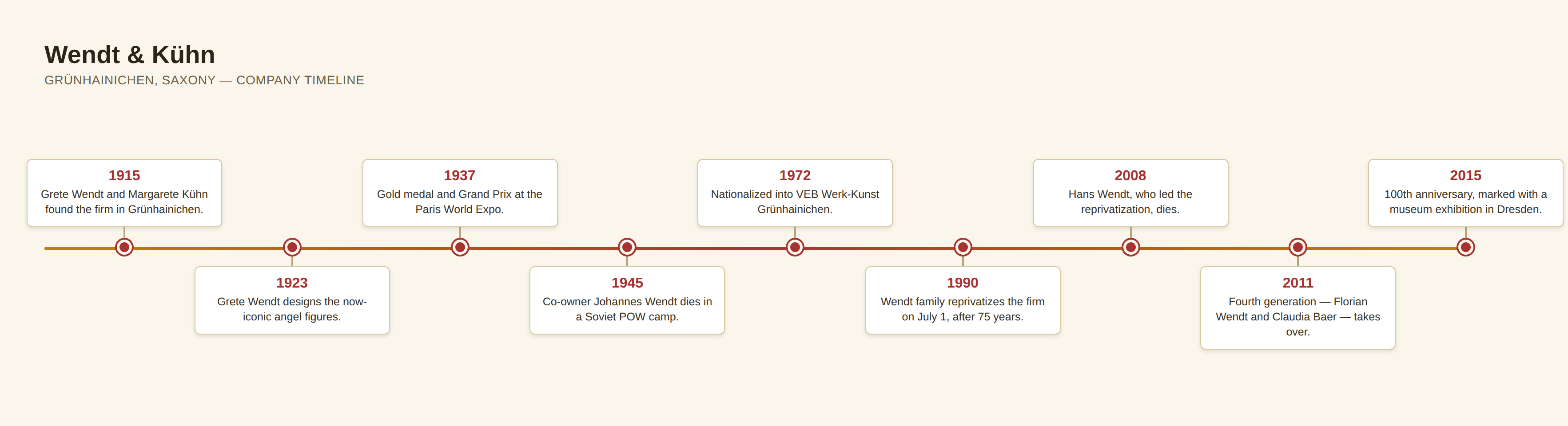
Wendt & Kühn makes the wooden angel figures with the unmistakable green-and-white striped wings — you've likely seen one on a mantel even if you didn't know the name. Grete Wendt, one of the first women admitted to Dresden's Royal School of Applied Arts, founded the company with her school friend Margarete Kühn in 1915, in the small Erzgebirge village of Grünhainichen. Grete designed the angel figure herself in 1923, and the company trademarked the design just two years later — a rare thing for a folk-art workshop at the time.
What sets Wendt & Kühn apart from most Erzgebirge makers isn't just the design, it's the survival story: nationalized by the East German state in 1972, then reclaimed by the Wendt family the moment reunification made that possible in 1990. It's now run by a fourth generation of the founding family, and in 2015 the company marked its 100th anniversary with an exhibition at Dresden's Museum für Sächsische Volkskunst.
The full story: two world wars, a Soviet POW camp, and a family that got its company back
Grete Wendt studied at the Kunstgewerbeschule in Dresden from roughly 1907 to 1911, one of the school's first female students, at a time when that alone was unusual. She founded the business with her school friend Margarete Kühn on October 1, 1915 — in the middle of the First World War, a conflict that touched the workshop directly: in 1917, with local men away at the front, the company employed French and Russian prisoners of war as lathe workers, and also produced wooden grave crosses.
Kühn left the partnership in 1920, but the company kept her name. Grete's brother Johannes Wendt joined as co-owner in 1919 and married designer Olly Sommer in 1930; together the family pushed the business toward the export markets that, by the late 1920s, accounted for roughly three-quarters of sales. The now-famous angel design, with its five-stroke wing pattern, dates to 1923 and won legal trademark protection in 1925 — protection that mattered, because Erzgebirge folk art was (and still is) widely imitated.
The Second World War hit the family hard. Production scaled back to make training models for military officer schools, and in September 1945, in the war's chaotic aftermath, Johannes Wendt was arrested by Soviet forces. He died in a Soviet prisoner-of-war camp near Cherepovets before the year was out. Grete Wendt continued running the business into the DDR period, receiving a state quality mark in 1949, but in 1972 — the same nationalization wave that swept up other Erzgebirge firms — the company was seized and renamed VEB Werk-Kunst Grünhainichen. Grete left the firm at that point and died in 1979. Johannes and Olly's son, Hans Wendt, stayed on as the nationalized firm's works director through the DDR years.
When reunification opened the door on July 1, 1990, Hans Wendt reclaimed the company for the family after 75 years of separation from private ownership, rebuilding it as Wendt & Kühn KG and growing the workforce from around 100 to nearly 200 artisans. He received Germany's Federal Cross of Merit in 2002 for that work and died in 2008. His children, Tobias Wendt and later Florian Wendt and Claudia Baer, have carried the company through a fourth generation — including a 2016 moment when Germany's then-president Joachim Gauck presented a Wendt & Kühn angel orchestra as a state gift to Japan's imperial family.